Madinah was the city that welcomed the Prophet Muhammad ﷺ when Makkah rejected him — the city where the first Islamic community was built, tested, and defended. Its surrounding sites carry the memory of some of the most significant battles, sacrifices, and turning points in early Islamic history. Visiting them is not a ritual requirement, but a way to walk through that history and reflect on the lessons scholars have drawn from it for over a thousand years.
This guide walks through the key ziyarat (visitation) sites in and around Madinah, their history, and the spiritual lessons associated with each.
Jabal Uhud is not simply a mountain — it is a witness to one of the most emotional turning points of early Islam. The Prophet ﷺ once described it with unusual tenderness:
“Uhud is a mountain that loves us, and we love it.” — Sahih al-Bukhari 2889, Sahih Muslim 1365
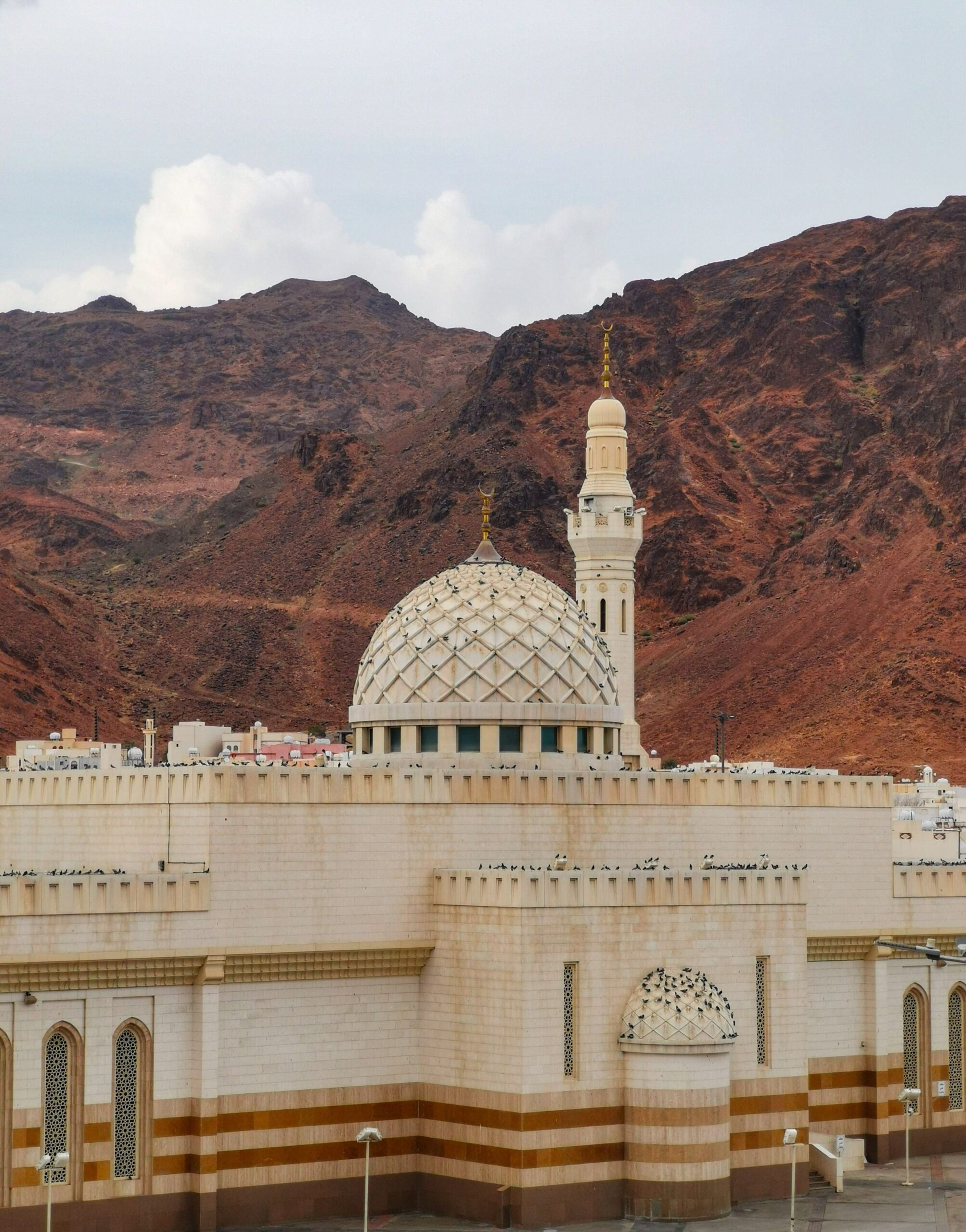
Three years after the Hijrah, the Quraysh marched from Makkah with roughly 3,000 men to avenge their defeat at Badr. The Prophet ﷺ set out with 1,000 companions, but as they reached the valley, Abd Allah ibn Ubayy — leader of a hypocrite faction — withdrew with 300 men, leaving 700 to face the Quraysh.
The Prophet ﷺ positioned the mountain at their rear for protection and stationed fifty archers on a nearby hill to guard the army’s flank, with a clear instruction:
“Even if you see us being eaten by birds, do not leave your position until I send for you.” — Musnad Ahmad 1475
The battle opened with Muslim success and the Quraysh began to flee — but many of the archers, believing the fight was won, left their post to gather spoils. Khalid ibn al-Walid, then still a disbeliever, exploited the opening and led a cavalry charge from behind, turning the tide. Hamzah ibn Abd al-Muttalib was martyred, and the Prophet ﷺ himself was wounded, his cheek cut by his own broken helmet. Still, he called out: “Come to me, O servants of Allah!” The companions rallied around him until the Meccans withdrew.
Visiting Uhud is for remembrance and supplication, not for touching graves or seeking blessings from the ground. The recommended greeting upon visiting is similar to: “Peace be upon you, O abode of believing people. Indeed we, if Allah wills, will join you. May Allah forgive us and you.” (Sahih Muslim, 2491)
Roughly 3 km south of Masjid an-Nabawi, Masjid Quba holds the distinction of being the very first mosque built in Islam. When the Prophet ﷺ arrived in Madinah during the Hijrah, he stayed among the Banu Amr ibn Awf and laid its foundation with his own hands, personally carrying stones alongside his companions.
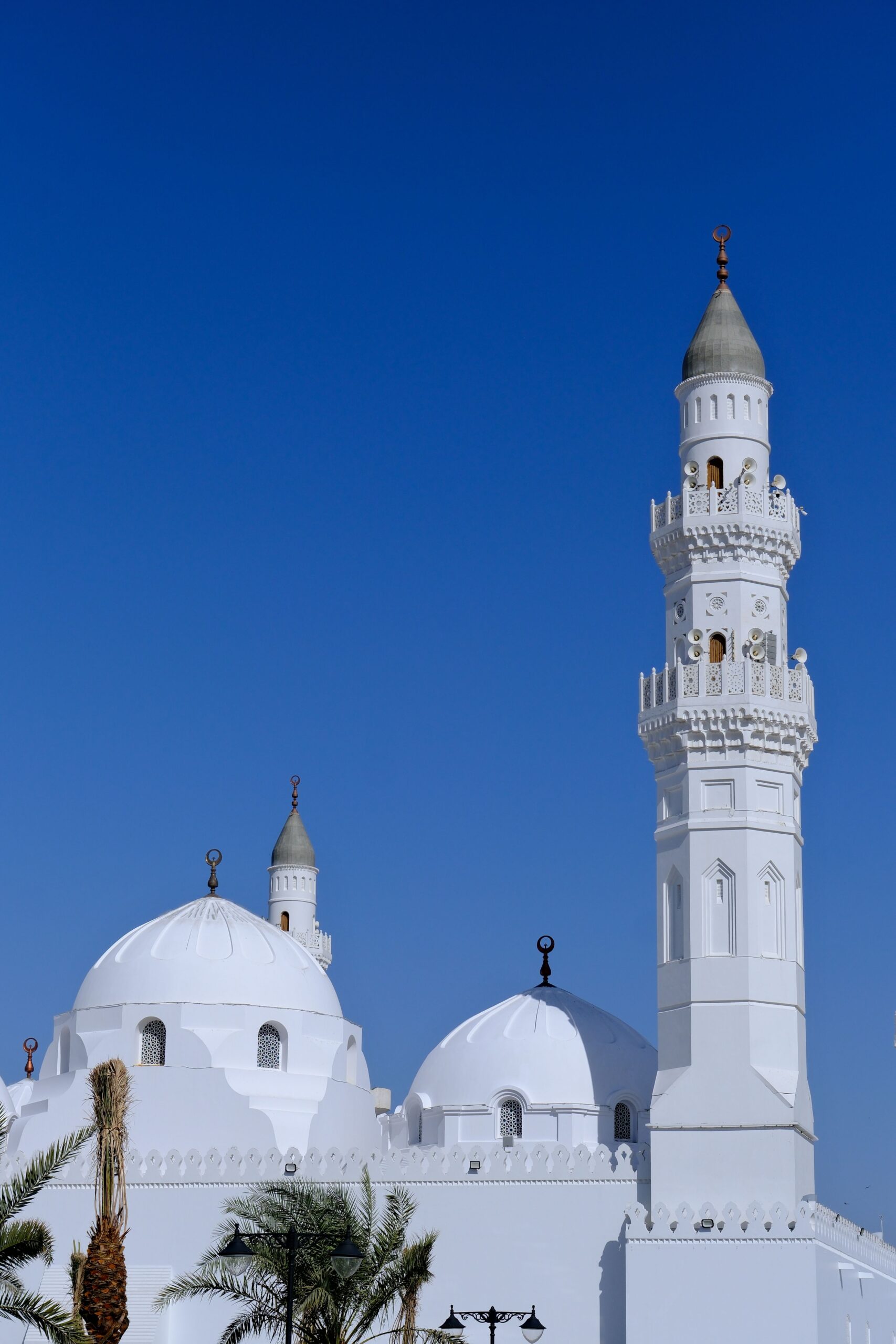
He described a specific reward for visiting it:
“Whoever purifies himself in his house, then comes to Masjid Quba and prays in it, will have a reward like that of an Umrah.” — Musnad Ahmad 2612; Sunan Ibn Majah 1412
Most scholars connect this mosque to a verse revealed about a house of worship founded from its very first day on sincerity rather than division:
“A mosque founded on righteousness from the first day is more worthy for you to stand in. In it are men who love to be purified, and Allah loves those who purify themselves.” — At-Tawbah 9:108
The Prophet ﷺ maintained a standing habit of visiting Quba every Saturday — on foot or by mount — to pray two rak’ahs there.
It is a confirmed Sunnah to visit Masjid Quba and pray there after performing wudu, even for residents of Madinah — but the visit should be an act of worship, not tourism. Touching the walls or seeking blessings from physical objects within it is not part of the practice.
East of Masjid an-Nabawi lies Baqi al-Gharqad, the oldest Islamic cemetery in Madinah and resting place of more than ten thousand companions, including several of the Prophet’s ﷺ own wives and children.
When Uthman ibn Maz’un (may Allah be pleased with him) passed away, the Prophet ﷺ chose this land as a burial ground and would visit it frequently, offering supplications such as:
“Peace be upon you, O abode of believing people. Indeed, we, if Allah wills, shall join you.” — Sahih Muslim 2491
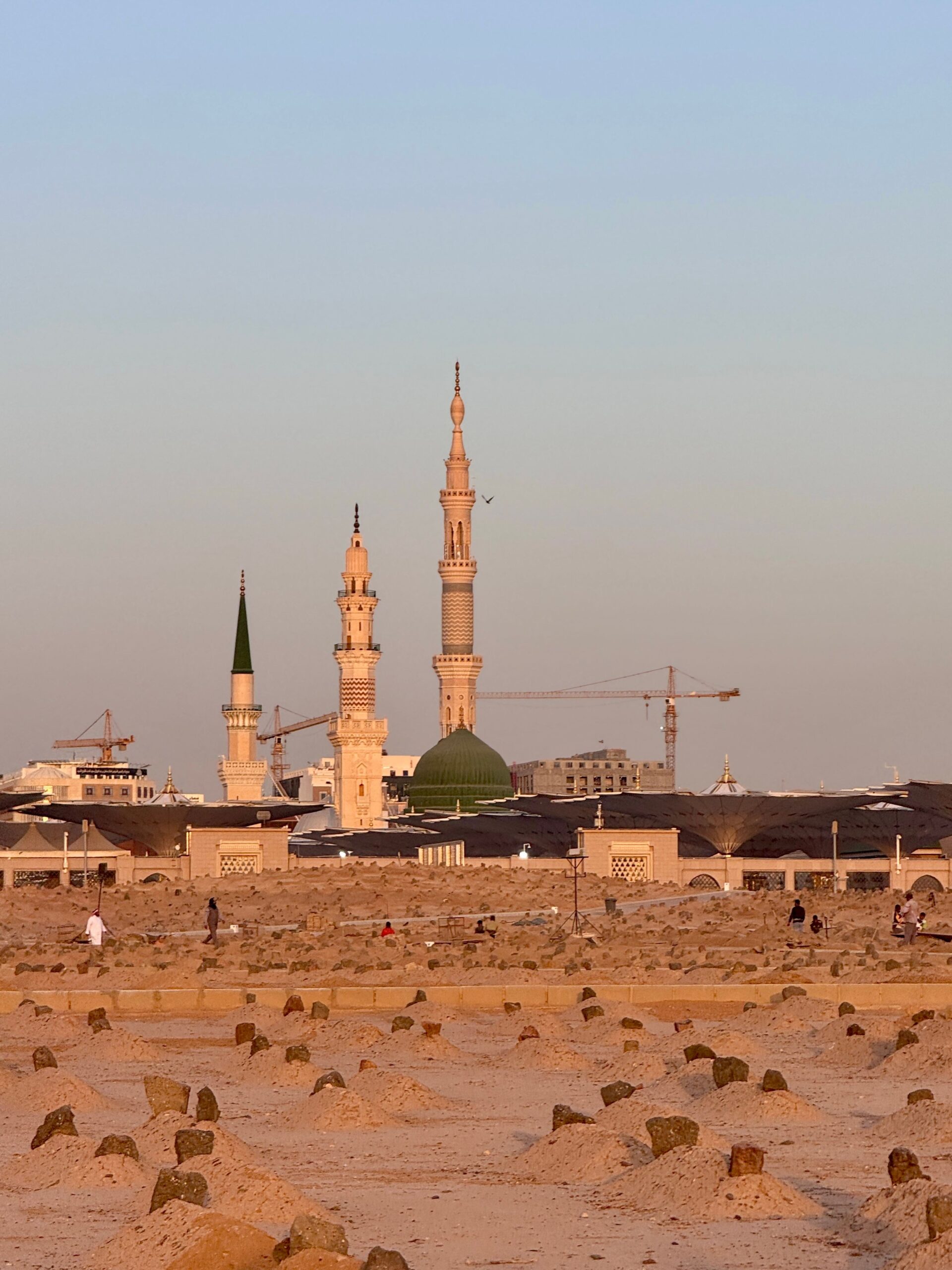
Visiting graveyards is a Sunnah for men, intended to prompt remembrance of death and supplication for the deceased. Seeking blessings from graves, touching them, or treating them as intermediaries contradicts the principle of Tawhid, and building domes or shrines over graves — as once existed here — has been removed by scholars for this reason. Women may visit occasionally, with modesty and without wailing.
About 500 meters west of Masjid an-Nabawi, this mosque marks the site where the Prophet ﷺ once led the community in Salat al-Istisqa, the prayer for rain, during a drought. As the prayer ended, clouds gathered and rain fell — giving the mosque its name, ghamamah, meaning “cloud.”
“He is the One who sends down rain after they have despaired and spreads His mercy. He is the Guardian, the Praiseworthy.” — Ash-Shura 42:28
Salat al-Istisqa is a confirmed Sunnah practice when rain is withheld, typically offered in an open space alongside repentance and charity. The mosque itself is visited as a historical marker of the event, not as a source of blessing.
Masjid al-Qiblatayn marks one of the most consequential moments in early Islamic practice — the point at which the direction of prayer changed from Bayt al-Maqdis (Jerusalem) to the Kaabah in Makkah. According to tradition, the Prophet ﷺ and his companions received this instruction mid-prayer during Dhuhr, and the entire congregation turned together without hesitation:
“We have certainly seen the turning of your face toward the sky, so We will surely turn you toward a Qiblah that pleases you. So turn your face toward al-Masjid al-Haram. And wherever you are, turn your faces toward it.” — Al-Baqarah 2:144
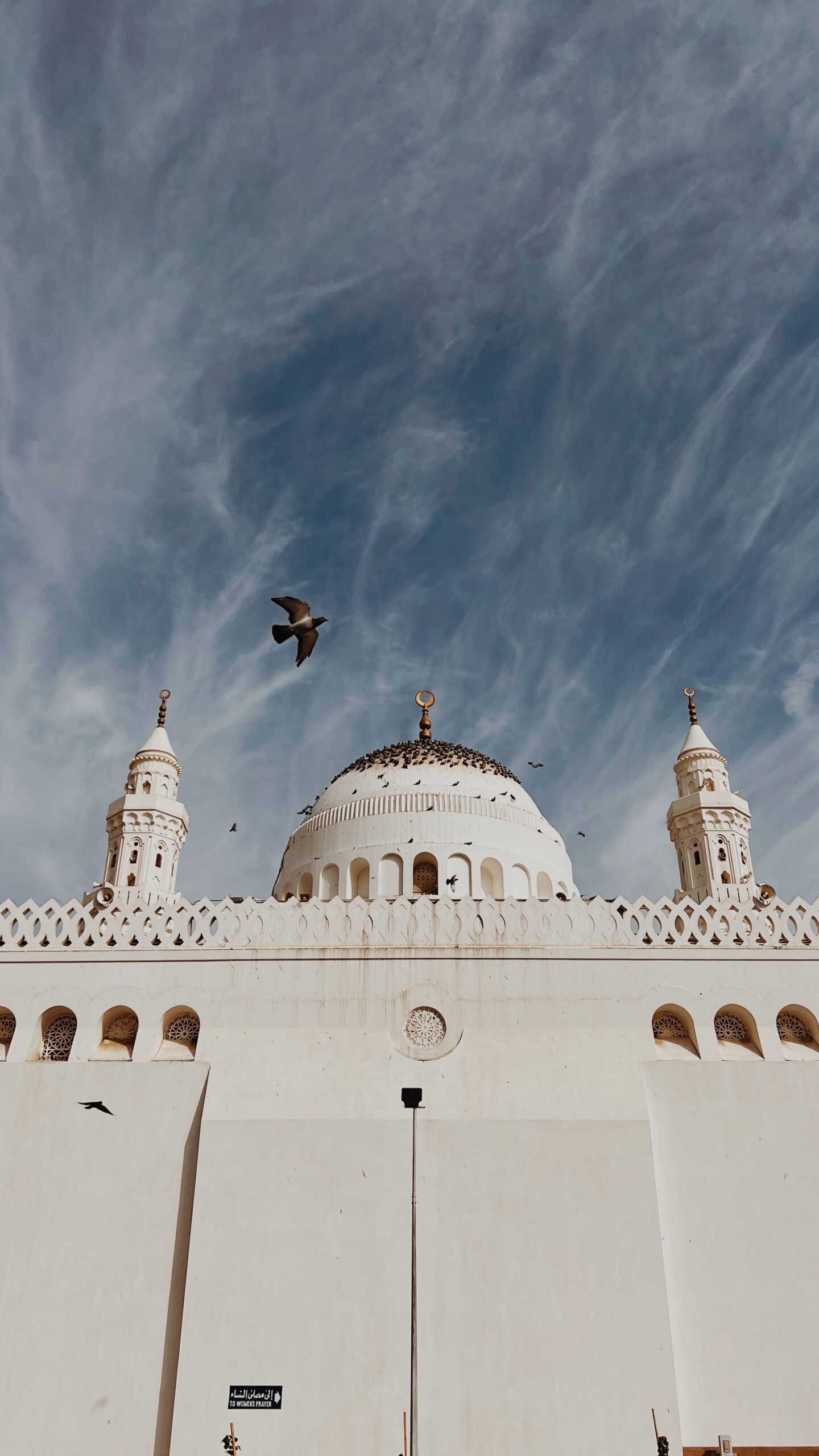
Facing the Qiblah is a pillar of prayer for those able to determine it; if a worshiper later discovers they prayed in the wrong direction, they correct course as soon as they know — mirroring what the companions did at this mosque. The site is remembered as a historical marker of that principle.
The area known as Al-Masajid as-Sab’ah — “the Seven Mosques” — stands on or near the site of Ghazwat al-Khandaq, the Battle of the Trench, one of the most decisive moments in early Islamic history. Though the exact number and positions of the mosques have shifted with later construction, the site as a whole commemorates this battle.
In the fifth year after the Hijrah, a coalition of over 10,000 fighters — Quraysh, Ghatafan, and allied tribes — marched on Madinah intending to end the Muslim community entirely. The Muslims numbered only around 3,000.
During the war council, Salman al-Farisi (may Allah be pleased with him) — a Persian companion who had traveled across the ancient world in search of true faith before reaching the Prophet ﷺ — proposed something unprecedented in Arabia: digging a trench around the city to block a cavalry assault. The Prophet ﷺ approved immediately.
For six days, the Muslims dug through cold and hunger along Madinah’s exposed northern flank, the Prophet ﷺ working physically alongside them. When the workers struck a rock too hard to break, tradition holds that the Prophet ﷺ took the pickaxe himself and struck it three times, each strike accompanied by a declaration of future victories — over Syria, Persia, and Yemen (Musnad Ahmad 14536).
When the confederate army arrived, they found the trench blocking their advance and were forced into a monthlong siege. The Muslims endured cold, hunger, and betrayal from Banu Qurayzah, a tribe within Madinah that broke its treaty and sided with the attackers. The Qur’an describes the intensity of that moment:
“When they came at you from above and below, and when eyes grew dim and hearts reached the throats…” — Al-Ahzab 33:10
Eventually, a fierce and sudden wind scattered the confederate camp, ending the siege without a decisive battle — remembered as a victory delivered directly by divine intervention:
“O you who believe, remember Allah’s favor upon you when armies came to attack you, and We sent upon them a wind and forces you did not see.” — Al-Ahzab 33:9
Salman’s own account of his journey to Islam is one of the most detailed conversion narratives preserved from the early Muslim community. Born in Persia to a Zoroastrian priest, he was captivated as a young man by the prayer of a group of Christians and left his father’s faith to search for truth. Over the following years he studied under a series of devout Christian teachers across Syria, Mosul, Nasibin, and Amman — each, before dying, directing him to the next, until the last told him a final prophet was soon to appear in a land between two lava fields lined with palm trees, who would eat gifts but not charity and bear a distinctive mark between his shoulders.
Following merchants toward Arabia, Salman was betrayed and sold into slavery, eventually ending up in Madinah — the very land his teacher had described. There he tested the signs given to him: he watched the Prophet ﷺ refuse to eat food offered as charity, then accept food offered as a gift, and finally glimpsed the mark on his back. Salman embraced Islam on the spot. The Prophet ﷺ later helped arrange his manumission from slavery, famously instructing the community, “Help your brother,” and himself planted the palm trees required to complete Salman’s freedom. The Prophet ﷺ also honored him directly:
“Salman is one of us, the People of the Household.” — Sahih Ibn Hibban 7071
Visiting the area of the Seven Mosques is permitted as historical remembrance, but there is no specific virtue tied to praying in each individual small mosque — their reward is the same as any other place of prayer. The purpose of visiting, as scholars frame it, is to revive faith by remembering sacrifice and trust in Allah, not to treat the stones themselves as significant.
South of Madinah lies the valley of Badr, site of the first major battle in Islamic history and one the Qur’an itself names Yawm al-Furqan — the Day of Criterion, the day truth was distinguished from falsehood (Al-Anfal 8:41).
On the 17th of Ramadan in the second year after the Hijrah, roughly 313 believers, poorly equipped with only two horses and seventy camels between them, unexpectedly found themselves facing a Quraysh force of over a thousand men after a planned caravan interception turned into open confrontation. When the Prophet ﷺ consulted his companions, Sa’d ibn Mu’adh (may Allah be pleased with him) pledged their full support on behalf of the Ansar, declaring that the community would follow him even into the sea if commanded.
That night, rain fell — steadying the believers’ footing while making the ground difficult for the Quraysh. The Prophet ﷺ spent the night in prayer, pleading:
“O Allah, fulfill Your promise to me! O Allah, if this small group of believers perishes, You will not be worshipped on Earth.” — Sahih Muslim 1763
Revelation followed, promising reinforcement: “When you sought help of your Lord, He answered you: ‘I will reinforce you with a thousand angels, following one another.'” — Al-Anfal 8:9
Visiting Badr today is a historical remembrance and an occasion for supplication on behalf of the martyrs — not an occasion for specific rituals or for seeking blessings from the ground itself. A mosque and a marked cemetery for the martyrs, including Ubaydah ibn al-Harith and Mu’adh ibn Amr, remain at the site roughly 150 km southwest of Madinah.
Each stop across Madinah’s ziyarat sites retells the same underlying story from a different angle: sacrifice at Uhud, purity at Quba, mortality at Baqi, obedience at Qiblatayn, sincerity and unity at the Trench, and trust in Allah at Badr. Together they trace a single theme scholars return to again and again — that faith is proven through obedience and action, not through belief alone.